
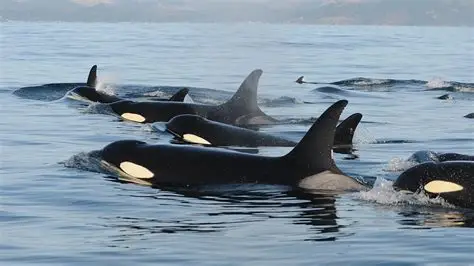
Local orca populations potentially threatened under federal changes to Endangered Species Act
Federal changes made to the Endangered Species Act may pose a threat to the critically endangered Southern Resident orca whales native to the Puget Sound area.
By Mya Leo
On July 17, the Trump administration finalized reforms made to the Endangered Species Act (ESA), which rolls back regulations on critical habitats (section 4(b)(2)) and removes the blanket rule that awards threatened species the same level of protection as endangered species (section 4(d)). The changes made to section 4(b)(2) will allow areas to be removed from critical habitat designation if the exclusion is not anticipated to cause the extinction of a species.
“For too long, the Endangered Species Act has been weaponized to stop almost any new project in America, driving up costs for families, weakening our competitiveness, and undermining our national security,” said Secretary Doug Burgum during the press release that announced the changes to the ESA.
Attorneys general from across 20 states, have filed 21 separate lawsuits against the U.S. Fish and Wildlife Service and the National Marine Fisheries Service to fight against the changes made to the ESA. Additionally, multiple other lawsuits have been filed against the departments by the Squaxin and Swinomish tribes, as well as multiple conservationist groups such as the Sierra Club. These lawsuits challenge the changes in regulations, stating that the broader definitions will make it too easy for the departments to decline protective statuses to current and future habitats and populations, which could lead to higher rates of extinction.
There are two distinct types of killer whales that pass through the Puget Sound area: the Brigg’s, or Transient orcas, and the Southern Resident orcas. Despite occupying the same region, these two differ greatly across diet, migration patterns, communication styles, genetic variations and morphologies. The two are so distinct from one another that they actively avoid each other despite being highly sociable within their familial groups and with other pods of the same type.
A groundbreaking 2024 study led to a proposal of species distinction between the two whale populations to the Society of Marine Mammalogy. The proposal was rejected with the claim that there was not enough data across global orca populations. The Society of Marine Mammalogy instead gave the Brigg’s and Southern Resident orcas official classification as subspecies of killer whales.
This determination faced pushed back from researchers due to the amount of evidence that suggests species distinction. It should be noted that Southern Resident orcas have had legal protection under the ESA as a “distinct population segment” since 2005. While no changes to the ESA will directly impact their endangered classification, there is concern that without proper species distinction, there may still be risks to the population if future changes are made or loopholes in the recent changes are found.
When speaking with evolutionary biologist and professor at UW Tacoma Morgan Heinz on navigating legal and scientific classifications, he said
“There aren’t really clear definitions of what a species is and that is okay since definitions within science are typically made to be placeholders until something better can be used– nature is a continuity that people try to put into buckets…From the taxonomist point of view we’re often not particularly bothered by saying we don’t know yet…the reason that the decision matters though is because you have legal protections for endangered species that are more strict and better defined than those protections of vulnerable species or species threatened with extinction”
When asked about why students should care about the changes made to the Endangered Species Act and what it may mean for at risk populations, Heinz said the following:
“The amount of biological diversity and the accessibility of that diversity; it’s spectacular. You can see all these different ecosystems and the biodiversity in them [which] makes it a very local point of pride, a local issue for protection and that means not only is that something we can enjoy it also becomes our responsibility” Heinz continued, speaking more on the Southern Resident Orcas,
“To recognize that we have a group of very intelligent, cultural animals –like mammals; they have their own cultures, their own songs, they communicate with each other very deeply that is so close by and so-so hanging by a thread. I think is a reminder of the responsibility we have to the things right near us.”
Lastly, when asked how interested students could get more involved with wildlife and environmental conservation efforts, Heinz said:
“Can’t save what you don’t know. If you’re gonna be in Point Defiance or you’re gonna go to Point Ruston just check the Orca Network and see if they’re there.” He then encouraged students to get involved with conservation efforts on campus through programs such as Huskies for Grit, the UW Tacoma sustainability Committee, or environmental research opportunities.


