
Students should not wait until graduation to start networking
The Washington Local Journalism Summit showed why students should take advantage of professional events, whether they happen off campus, on campus or through UW Tacoma networks.
By Syed Huzaifa Bin Afzal
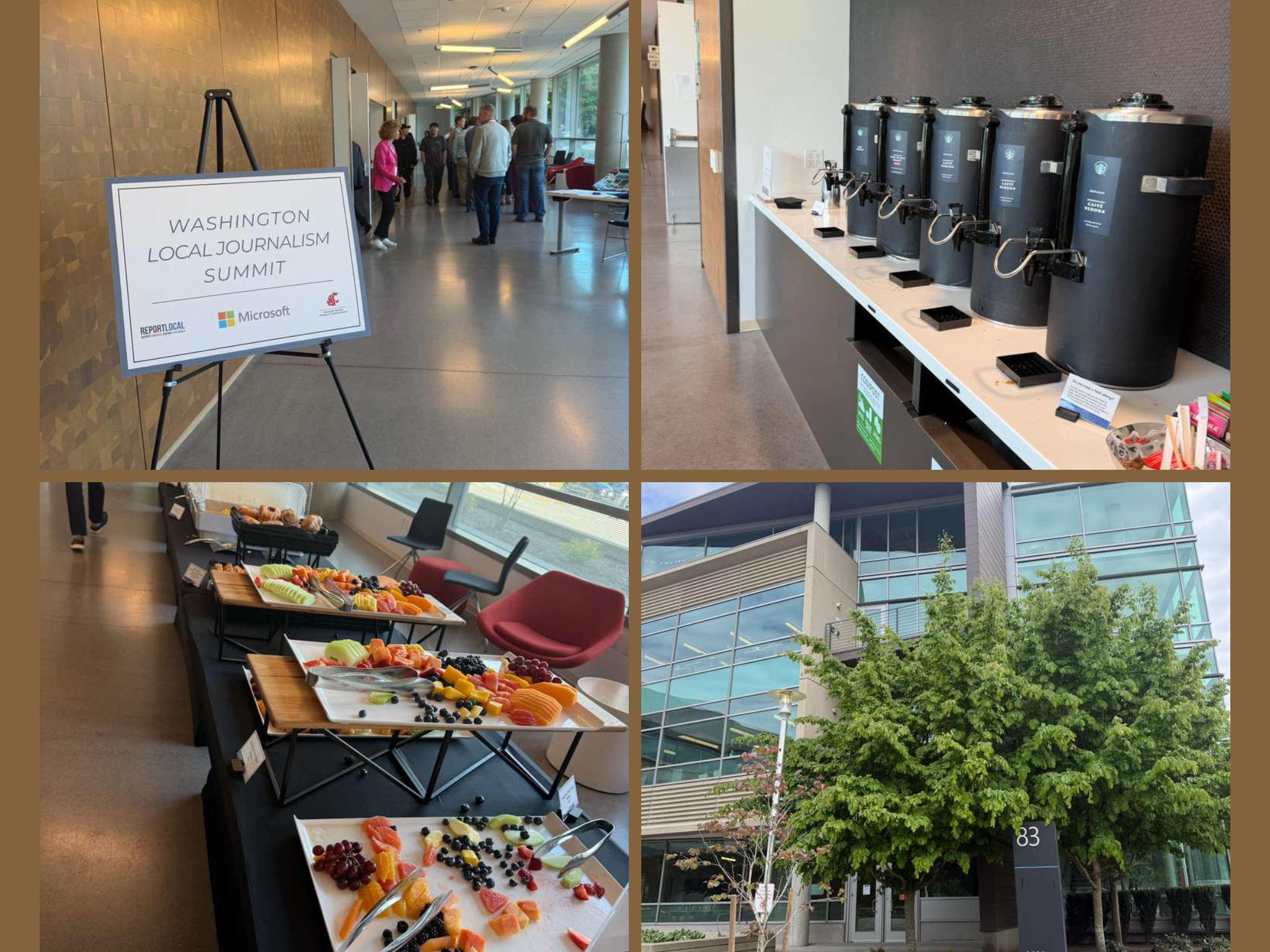
Attending the Washington Local Journalism Summit at Microsoft’s Redmond campus on Monday, May 18 reminded me of something many students do not fully realize until they are close to graduation: opportunities rarely arrive through applications. Many of them begin through conversations with people you meet when you choose to show up.
As students, we often think about career preparation in a narrow way. We update our resumes, apply to internships, submit job applications and wait for someone to respond. Those steps matter, but they are not enough. The summit showed me that professional growth also happens when students step into rooms where people are already discussing the future of their field.
The summit brought together journalists, newsroom leaders, Microsoft team members, Report for America representatives and Washington State University’s (WSU) Edward R. Murrow College of Communication. The agenda included sessions on local news funding, public policy, AI concepts journalists should understand, journalism in the age of AI and how AI is changing truth and security.
Because portions of the summit operated under the Chatham House Rule, which allows people to share ideas from a discussion but not identify who made specific comments, I am not using this column to attribute specific comments from closed discussions. Instead, I am focusing on the broader lessons students can take from being in professional spaces like this.
For a student journalist, that kind of room is valuable because it gives context that a classroom cannot always provide. It is one thing to learn that journalism is a public service. It is another thing to sit near working journalists and hear how they are trying to keep local news alive, how small newsrooms are covering entire communities, and how technology is changing the basic workflow of reporting.
As a Master of Cybersecurity & Leadership student, the summit was also valuable because it gave me an inside look at how journalists, technology teams and newsroom leaders are thinking about AI, trust and security before those issues reach the public in simplified form. The sessions on AI concepts and on how AI is changing truth and security connected directly to my academic background in cybersecurity.
For me, the event was not only about journalism. It was about seeing how security, responsible AI, public trust and local reporting now overlap. Being in the same room with journalists and Microsoft team members helped me understand how the industry is preparing for problems such as deepfakes, misinformation, AI-generated content and source protection. That kind of inside understanding is difficult to get only from class readings or online research.
The summit was also a reminder that networking is not just about collecting LinkedIn connections. It is about learning how professionals talk about problems, what questions they ask and what skills they value. When students attend these events, they get a clearer sense of where their classroom learning fits into the real world.
This is why students should treat professional events as part of their education, not as optional extras. A summit, panel, workshop or campus showcase may not look like a class assignment, but it can teach students what skills they need next. It can also introduce them to people who may later become mentors, collaborators or employers.
Students sometimes avoid events because they feel they are not experienced enough to be there. I understand that feeling. Walking into a room full of professionals can be intimidating. But being a student is actually one of the best reasons to attend. People are often willing to explain their work, answer questions and share advice when they know someone is still learning.
The mistake is waiting until after graduation to start those conversations. By then, students are often under pressure to find work quickly. Networking becomes stressful because it is tied directly to job searching. When students attend events while still in school, they can build connections more naturally. They can ask better questions, learn without needing an immediate outcome and discover career paths they may not have considered.
The summit also showed why students should look beyond their own major. A journalism event at Microsoft was not only about reporting. It connected media, AI, cybersecurity, public policy, funding, community trust and technology. For UW Tacoma students, that kind of cross-field exposure is especially useful because many of us are preparing for careers that will not fit neatly into one category.
A cybersecurity student can learn from journalists about verification and public trust. A business student can learn about revenue models and local economies. An education student can learn about how information reaches communities. A computer science student can learn why technology tools must be built with real users in mind. These are the kinds of lessons students may miss if they only attend events directly tied to their major.
The same lesson applies on campus. UW Tacoma regularly offers events that give students chances to meet people, present work and build experience. UHackathon 2026, held May 22 and 23, gave students a chance to form teams, build a project and practice solving problems under pressure. The eighth annual Applied Project Showcase and the SET Engineering Design Showcase are scheduled for May 29, giving students opportunities to see how academic projects connect with industry and real-world challenges.
Students can also attend the MCL & MSIT Poster Presentations on June 5, where graduating Master of Cybersecurity and Leadership and Master of Science in Information Technology students will present research projects. The Sciences and Mathematics Undergraduate Research Symposium is scheduled for June 11 and will showcase undergraduate capstone research. Students looking for more opportunities should also check the UW Tacoma events calendar regularly.
These events may seem small compared with a summit at Microsoft, but they serve a similar purpose. They put students in rooms where ideas, projects and professional relationships can begin. They also help students practice explaining their work, which is one of the most important skills for life after graduation.
UW Tacoma students should take these opportunities seriously. Attending an event does not guarantee a job, internship or professional connection. But not attending almost guarantees missing the chance to make one.
Students do not have to wait for major off-campus summits to build these connections. UW Tacoma’s Career Development & Education office hosts career and internship fairs during the academic year, including fall and spring opportunities, and those events serve the same purpose: helping students meet people, ask questions and practice explaining who they are before graduation.
The lesson I took from the Washington Local Journalism Summit is simple: students should not wait for an opportunity to find them. They should go where conversations are happening, introduce themselves and listen carefully. Sometimes one event can lead to a story, a mentor, a job lead or a new way of seeing your own future. That is reason enough to show up.


