
UWT interviews campus musicians: Where is your community?
Musicians at UWT search for community, music club dormant, find out where they find each other.
By Rae Watkins
The University of Washington is known for its thriving arts community. But at UWT, where we don’t have many performing arts-specific programs, musicians are finding themselves searching for a stronger community to keep this culture alive. We do have a performing arts focus on our Arts, Media, and Culture degree through Interdisciplinary Arts and Sciences, but it’s not specifically tailored to the rigorous practice and curriculum a music degree entails.
Under the surface, UWT is home to incredibly talented musicians, some with degrees in music, some with backgrounds in performance, and some with in-depth knowledge of music as a social narrative. The Ledger interviewed campus musicians Renzo Aquino and Armin Kamsi, to shed some light on the music scene at UWT.
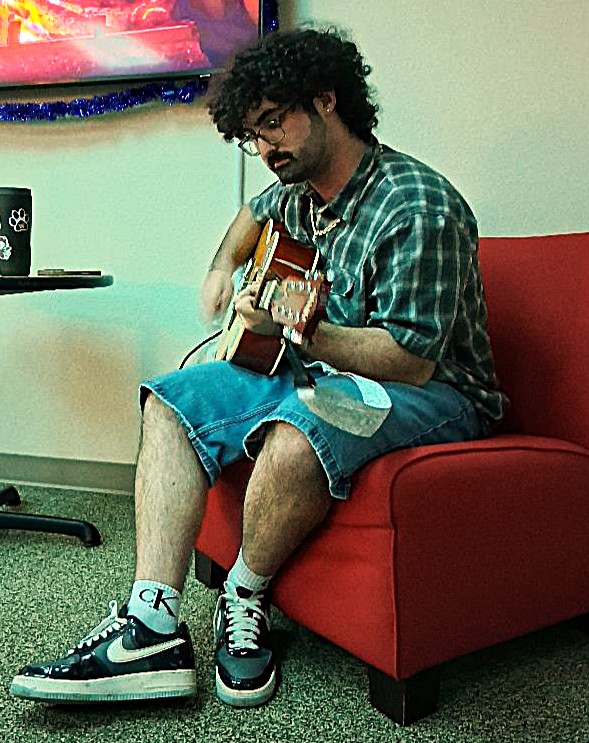
Armin Kamsi , a first year student majoring in Computer Science and Systems, is a guitarist. He plays electric, acoustic and bass. A fan of indie and acoustic tunes, Kamsi has found himself practicing in the Court 17 parking garage but looks forward to playing for UWT events. One such event was the Winter Warming Event hosted by the Husky Success Series. You can also find him at campus arts nights, including open mics, the upcoming Block Party and the 30th Edition Tahoma West Launch Party.
Renzo Aquino, a senior double majoring in Computer Engineering and Systems and Computer Science and Systems, plays over 20 instruments; so many, he says he’s lost count. He performs, but he also composes and has even arranged music for one of UW Seattle’s orchestras. His repertoire ranges from video game music to classical to covers and originals. Aquino plays on campus, as well as in Seattle, Olympia and across the South Sound region in multiple ensembles and bands. He enjoys ensemble work and the community it offers, and he is currently focusing his efforts on composition.

Students relate to music in myriad iterations. From a learning tool to a coping tool, to the momentum behind success, music touches each of us in a different but profound way.
Some students use music to study. The added stimulation over a quiet room often proves just the right amount to focus. Kamsi listens to soft acoustic ballads rather than rock when studying, preferring to lock into a more melodic sound. Aquino prefers video game music but as someone with a trained ear, finds music distracting, as he defaults to analyzing its rhythms and notes.
Music plays a critical role in bringing communities together. Everything from family barbecues to social movements has been woven together by the fabric of song. Kamsi said, “in our community, we need more songwriters or people interested in collaborating on original songs” and hopes to find some on campus. More than just finding community or studying, students often cope with the turmoil of modern times through music. There’s a song for everything, from teen angst, to romance, to protests. Kamsi finds hope and reminders in music.
“I’ve been listening to older anti-facist songs, like the classic This Land Is Your Land by Woody Guthrie, and The Times They Are A-Changin by Bob Dylan to give me a sense of hope for our generation’s future,” Kamsi said.
Aquino finds his community by playing music with others. In ensembles, choirs, and orchestras, Aquino enjoys working with a group and the skills that come with listening to each other and creating art together. Without an academic music program at UWT, Aquino finds that traveling out of the area is the best way to find talent that fits his purpose.
Aquino and Kamsi agree that the music scene at UWT could be bigger, and finding specific members and equipment for a group has been difficult. Drums, amplifiers, and other essentials are in limited supply, as funding for exploratory instruments is not as available.. While you can check out a variety of equipment from IT on campus, such as guitars, synthesizers and more, it might be harder to find a drum set or horns, as they are more difficult to store and require specific and specialized care to remain sanitary.
Clearly, students need more music events, groups, and culture on campus. But without a program here, how can students hope to find this community within our busy lives? Between classes responsibilities, and friends, taking more time for a club or band might seem impossible. Students like Kamsi and Aquino bring life to the campus space, and offering more support for communities of musicians might go a long way toward bringing a more lived-in atmosphere to our urban spread.
Campus musicians used to have the Music Club (Registered Student Organization) to turn to, but since AY 2025-2026, the club has been dormant. When officers graduate, RSO’s often have issues maintaining longevity if no students come forward to lead it. Additionally, club officers cannot be members of paid student leadership due to conflict of budgeting interest. These constraints limited Music Club’s ability to find officers to carry on the mantle for a bulk of this year.
Time here is limited, and turnover is one of the most dangerous factors in establishing longevity for any campus group. From advisory committees, to campus clubs like this, students need to keep staying engaged in order for the groups to continue. As the revolving door of students turns, fresh perspectives bring different interests to campus, and some RSO’s find themselves on the chopping block.
Fortunately, there may be a revival in the near future for Music Club. They’re currently looking for one more officer before they can officially declare themselves an RSO, and this could be any student. If you’re a musician looking for a community, it’s out there. But it takes some networking to find one on campus. So, get outside, play your music in shared spaces and build the community you’re looking for.


You must be logged in to post a comment.