
UW Tacoma campus plan moves student life to the center
The long-term framework would add housing, dining, student services and green space as the university plans for a larger, more connected campus.
By Syed Huzaifa Bin Afzal
UW Tacoma’s updated Campus Master Plan lays out a long-term vision for a larger university, but one of its clearest priorities is more immediate: moving student life closer to the center of campus.
The plan, developed with Bjarke Ingels Group, is intended to guide campus growth over the next 20 to 25 years. It supports a projected enrollment of 10,000 students and identifies about 1.4 million square feet of additional development capacity, according to UW Tacoma’s Campus Master Plan page. The university says the plan focuses on academic growth, inclusive campus spaces, sustainability and stronger connections to Tacoma’s urban environment.
Most visible changes for students would likely come through housing, dining and a more active campus core. UW Tacoma has already received approval to seek development partners for a housing and dining project that would add 500 beds and create the campus’s first traditional dining hall, with a targeted opening in late 2029, according to UW Tacoma News & Information.
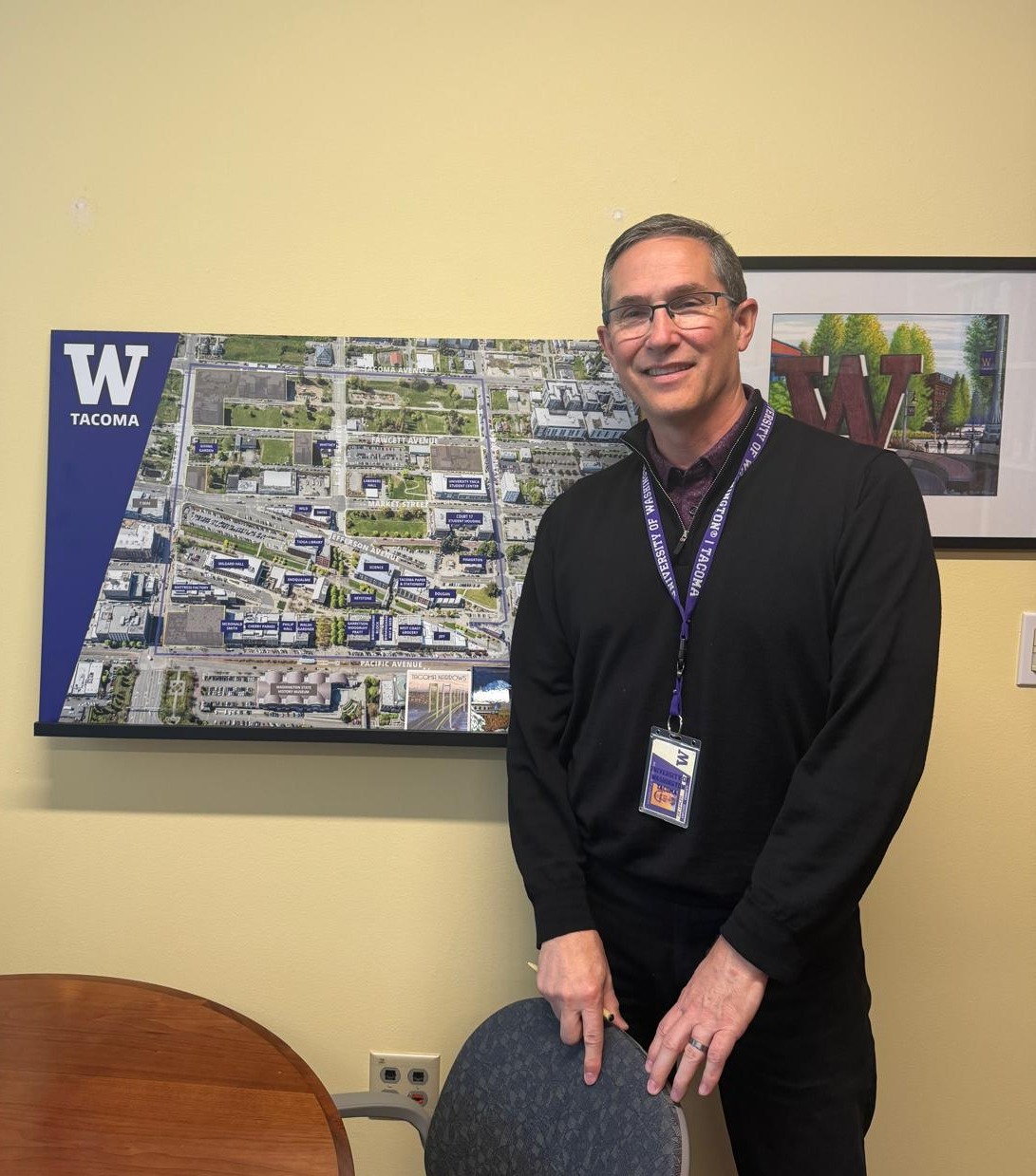
In an interview with The Ledger at his office, Joe Lawless, UW Tacoma’s chief strategy officer who has worked at UW Tacoma for almost 19 years, said the plan should not be read as a final design for every future building. Instead, he described it as a guide for how individual projects fit into a larger vision.
“It’s not a design, it’s a framework for how campus will develop.” Lawless said.
Lawless, said the campus’s future is tied to the larger story of downtown Tacoma. He described how downtown struggled in the 1970s after retail and office activity shifted toward suburban malls, and how community leaders later saw a public four-year university as one way to help bring life back to the city’s core.
UW Tacoma was founded in 1990 and later moved into its permanent location along Pacific Avenue, where the university now occupies a 46-acre campus with 22 buildings, according to UW Tacoma News & Information. The new master plan builds on that history while preparing the university to grow farther up the hill, with future boundaries stretching from South 17th Street to South 21st Street and from Pacific Avenue to Tacoma Avenue.
The updated plan came out of a yearlong process that included students, faculty, staff and community members. Lawless said UW Tacoma received 18 proposals from architecture and planning firms before selecting Bjarke Ingels Group. From there, planners gathered feedback, tested ideas and revised the framework before the final plan took shape.
A central question in that process was where student life should sit on campus. Lawless said planners considered whether academic buildings should remain at the center with student services around the edges, or whether UW Tacoma should take a different approach.
“We really wanted a model that centers students,” Lawless said. “Your physical campus should represent your values.”
That idea is shaping the first major projects connected to the plan. During the interview, Lawless used a campus map to explain how the planned housing and dining project would be located near Court 17 Student Housing and the University Y Student Center. The area between future housing, dining and student services would become a central commons where students could gather instead of simply passing through campus.
“This is literally the geographic middle of campus,” Lawless said, describing the planned center area.
The plan also includes renovation work for the Tioga Building and the Swiss-Wild Building, also known as Swiss Hall. UW Tacoma has said those two historic facilities are expected to undergo renovations, with Swiss Hall planned as a future hub for student programming and a new campus welcome center, according to UW Tacoma News & Information.
Lawless said one goal is to move Student Affairs from the Mattress Factory, which sits near the edge of campus, into a more central location. Combined with housing, dining and open gathering space, that shift would make the middle of campus more active.
“Student affairs, this big commons area, the dining hall, student housing that would make the environment lively in the center,” Lawless said.
The university’s goal is to open the housing project in autumn 2029 if planning stays on schedule, Lawless said. Renovation work involving the Swiss-Wild Building and Tioga Building could follow around fall 2030, though that project still depends on capital planning and funding.
Even with more student housing, Lawless said UW Tacoma is expected to remain mostly a commuter campus. The point, he said, is not to turn it into a fully residential university, but to create enough activity that students have more reasons to stay on campus before and after class.
“With more students living on campus, it creates more energy,” Lawless said. “Even the commuter students who come here will benefit from that.”
Food access is part of that same student-life question. UW Tacoma has added more food options in recent years, but the campus still does not have a traditional dining hall. Lawless described the area around campus as a food desert and said dining space would serve both practical and social needs.
“Access to food is really important,” Lawless said. “Having a dining hall is access to more affordable food through a meal plan, and social space.”
The plan also looks beyond the center of campus. Pacific Avenue has historically acted as UW Tacoma’s front door, but Lawless said the university does not want Tacoma Avenue to feel like the back of campus as development expands uphill.
“We want another front door on Tacoma Avenue,” Lawless said. “That it’d be just as active and just as connected to the community and the Hilltop.”
Green space and mobility are also major parts of the plan. The Campus Master Plan calls for improved pedestrian pathways, multimodal transit connections and wayfinding systems. It also identifies a “vibrant campus heart” and public spaces meant to support a more active campus environment.
Lawless said one planned green corridor is designed around a view toward Mount Rainier, creating an axis through campus. He also said planners spent time thinking about accessibility because UW Tacoma sits on a hill, making movement through campus difficult for some students and visitors.
The university has also started work on a micro forest project located at Broadway and S.17 Street next to Pinkerton and Dougan building, which Lawless described as a collaboration involving students, faculty, facilities, urban studies students and civil engineering students. He said the project uses the Miyawaki method, a dense tree-planting approach intended to help small ecosystems grow faster.
For Lawless, the campus’s open spaces are not only for students. He said nearby residents already use parts of campus to walk, gather and spend time outdoors, making UW Tacoma part of downtown Tacoma’s public life.
“We want Tacoma to feel like this campus belongs to them,” Lawless said. “It’s here because of the community and for the community.”
The plan also connects to academic growth. Lawless said future facilities will need to align with academic programs and workforce needs, especially in areas such as health care, social work and engineering. But he emphasized that growth must happen carefully, with academics, student experience and physical infrastructure developing together.
“You have to incrementally grow both academics, student experience, the physical infrastructure,” Lawless said. “They all have to grow together.”
These changes may be several years away, but Lawless said the master plan is already influencing decisions about housing, dining, student services, campus edges and future academic space.
“These projects that we’re moving forward wouldn’t be moving forward if we didn’t have the master plan,” Lawless said.


