
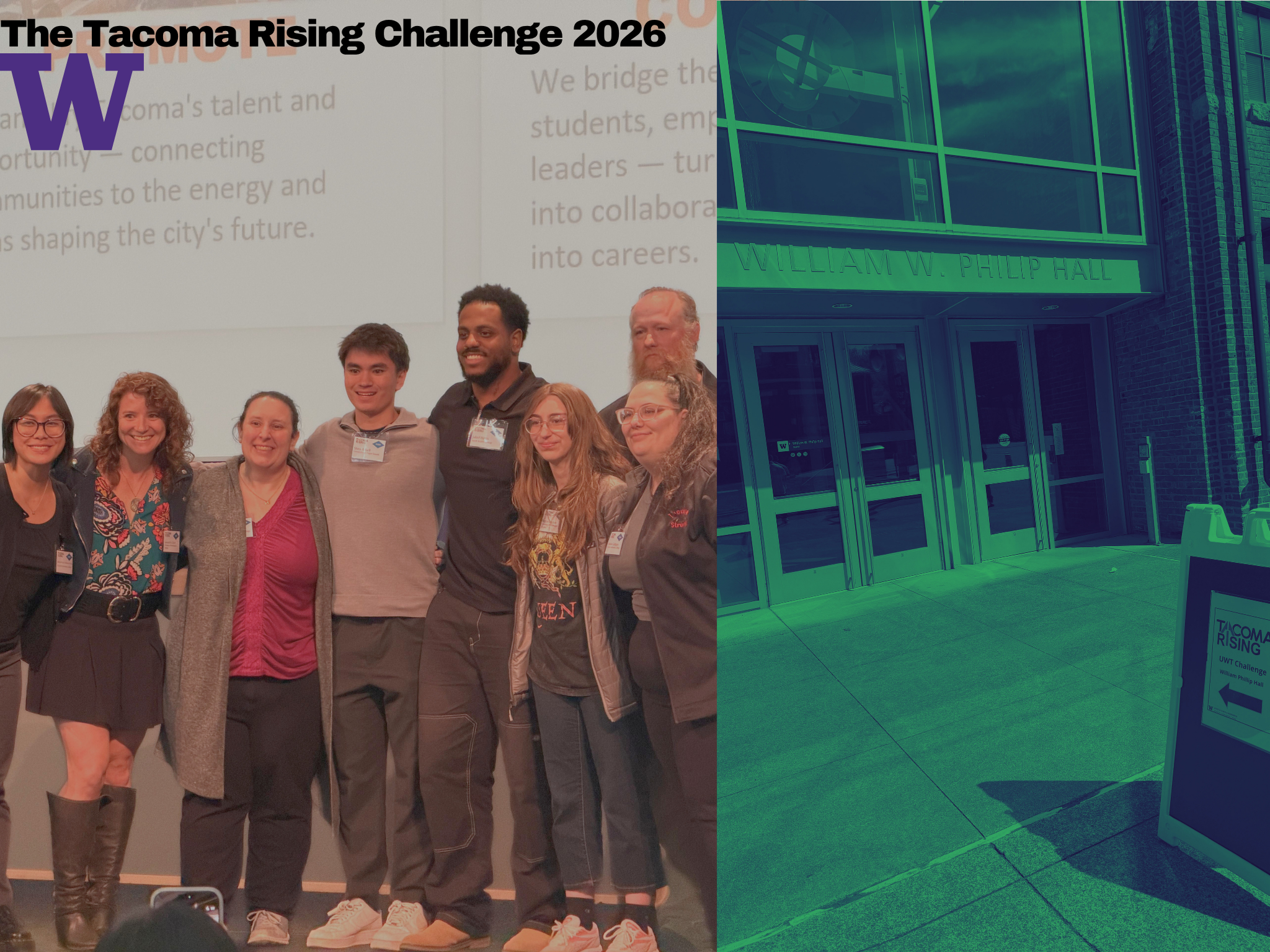
Tacoma Rising Challenge brings student teams to UW Tacoma to pitch ideas for Pacific Avenue
The daylong competition paired student teams with mentors to develop revitalization proposals for Pacific Avenue. Organizers said the goal is to connect students with industry professionals and generate ideas for Tacoma’s downtown corridor.
By Syed Huzaifa Bin Afzal
The Tacoma Rising Challenge returned to UW Tacoma at William Phillip Hall (WPH) on April 24, bringing students, business mentors and community leaders to campus for a daylong competition focused on Pacific Avenue, the corridor that connects the university to downtown Tacoma. The event asked student teams to develop and present proposals for the corridor after several hours of structured work with mentors, according to the event listing and Tacoma Rising descriptions.
The challenge format was designed as a fast-paced sprint. The Eventbrite listing described the 2026 challenge as a one-day competition where student teams work on Pacific Avenue-focused ideas and present their work to a judging panel.
During opening remarks, a slide shown to attendees summarized the scale of participation as seven colleges and universities, 50 student participants and 40 industry mentors working toward one “bold project.” Organizers structured students into five teams for the day, and after the final presentations, judges selected Team 3 as the winner among the five teams.
Becca Lamberg, a Tacoma Rising team member and UW Tacoma 2023 alumna, said students spent most of the day building proposals before moving into final presentations.
“The students have just been working for five hours on these projects,” Lamberg said, adding that each team combined different academic backgrounds, including marketing, finance, urban design, civil engineering and business.
Lamberg said the interdisciplinary mix was intended to help teams approach the corridor from multiple angles before pitching their recommendations.
Reid Fetters, founder of Tacoma Rising, said the challenge was created to strengthen ties between the region’s student pipeline and the local economy. Fetters said the organization’s goal includes developing founders, retaining talent and building “place.”
“There’s seven colleges in this area and we need to keep those students here,” Fetters said, describing the event as one way to connect students to mentors and local opportunities.
Fetters said Tacoma Rising piloted the model last year and expanded it for 2026. He said the first event brought together roughly two dozen students and a smaller group of mentors, and that some students later gained job opportunities through mentor connections. Fetters said the challenge is intended to create professional relationships while giving students practical experience working under a deadline.
UW Tacoma leaders framed the event as both an educational experience and a downtown-adjacent planning exercise. Joe Lawless, UW Tacoma’s chief strategy officer, said the corridor matters to students because it shapes how they enter the university area and how connected campus feels to surrounding neighborhoods. Lawless said the cross-institution mix can also change the way teams see the corridor. He said having students from the University of Puget Sound, Tacoma Community College, Pacific Lutheran University and other schools in the room “creates a much more diverse team with different ideas, different perspectives,” adding that some students may be encountering the Pacific Avenue corridor with “whole new eyes.”
Michael Catsi, president and chief executive officer of the Economic Development Board for Pierce County, served as one of the judges. Catsi said teams often arrived at similar themes but packaged their ideas differently.
“I thought everyone did an amazing job,” Catsi said, adding that teams made connections to nearby destinations and institutions when describing how Pacific Avenue could function as an entry point to downtown and campus areas.
Catsi said the presentations also showed how student teams can translate broad ideas into practical proposals under time constraints. He said one potential next step after a competition like this is identifying strong elements across proposals and exploring how they could be combined or advanced through future planning and partnerships.
A mentor for the winning team 3, Syed K. Jamal, founder of Grit City Studio, said the day provided a realistic experience in teamwork and narrowing scope. After Team 3 was announced as the winner, Jamal said the team’s progress mattered as much as the result.
“I’m very excited,” Jamal said, while emphasizing that students should focus less on “winning and losing” and more on learning how to work through ideas and constraints.
The Tacoma Rising Challenge is one of several public-facing programs Tacoma Rising has promoted as part of its work to connect emerging talent with employers and civic partners, according to The Rising Cities event page. A South Sound Business report on the April 24 challenge similarly described the event’s competition format and its focus on shaping ideas for Pacific Avenue.
For students, the event offered two takeaways: a chance to work with professional mentors on a real corridor near campus, and a look at how civic and business stakeholders evaluate proposals that combine design, finance, and community use. Organizers said the event’s emphasis on cross-sector mentorship is intended to continue beyond the day itself through follow-up connections and professional networks.
As the event concluded, organizers and judges said the Challenge was designed to be more than a one-day competition, with ideas and connections intended to carry forward after the final presentations. Team 3 was selected as the winner among the five teams, and students finished the day with a case-study style experience working under real deadlines alongside industry mentors.


