Building the future with AI Purple: UW students join forces with UW-IT to shape next-gen AI
Following The Ledger’s earlier coverage of UW’s AI initiatives, UW-IT’s lead AI architect Jared Reimer offers an inside look at AI Purple revealing how the platform blends privacy, creativity and collaboration to prepare students for the AI-driven future.
By Syed Huzaifa Bin Afzal
In the previous brief, The Tacoma Ledger covered the University of Washington’s growing efforts in artificial intelligence.
A closer look at the heart of that plan, AI Purple which is now live. In an exclusive conversation, Jared Reimer, lead AI architect at UW-IT, shared how the tool is evolving and why student participation will define its future.
An exclusive conversation with Jared Reimer, lead AI architect at UW-IT, revealed the heart behind AI Purple and gave details about how the tool is evolving and why student participation will define its future.
“The key concept and the reason for the program is AI for all,” said Reimer. “What we don’t want is an inequitable situation where some students have the $200 plan, some of them have the $20 plan, some of them have the free plan, and some of them have nothing.”
AI Purple provides a unified portal where users can write code, analyze data, generate presentations and conduct research using a set of trusted AI agents.
These agents run on models such as GPT-4.1 Mini, GPT-5, Llama, Mistral and DeepSeek each offering a balance between speed and accuracy depending on the task. AI Purple serves as a one-stop platform giving the UW community free access to a wide range of premium AI models.
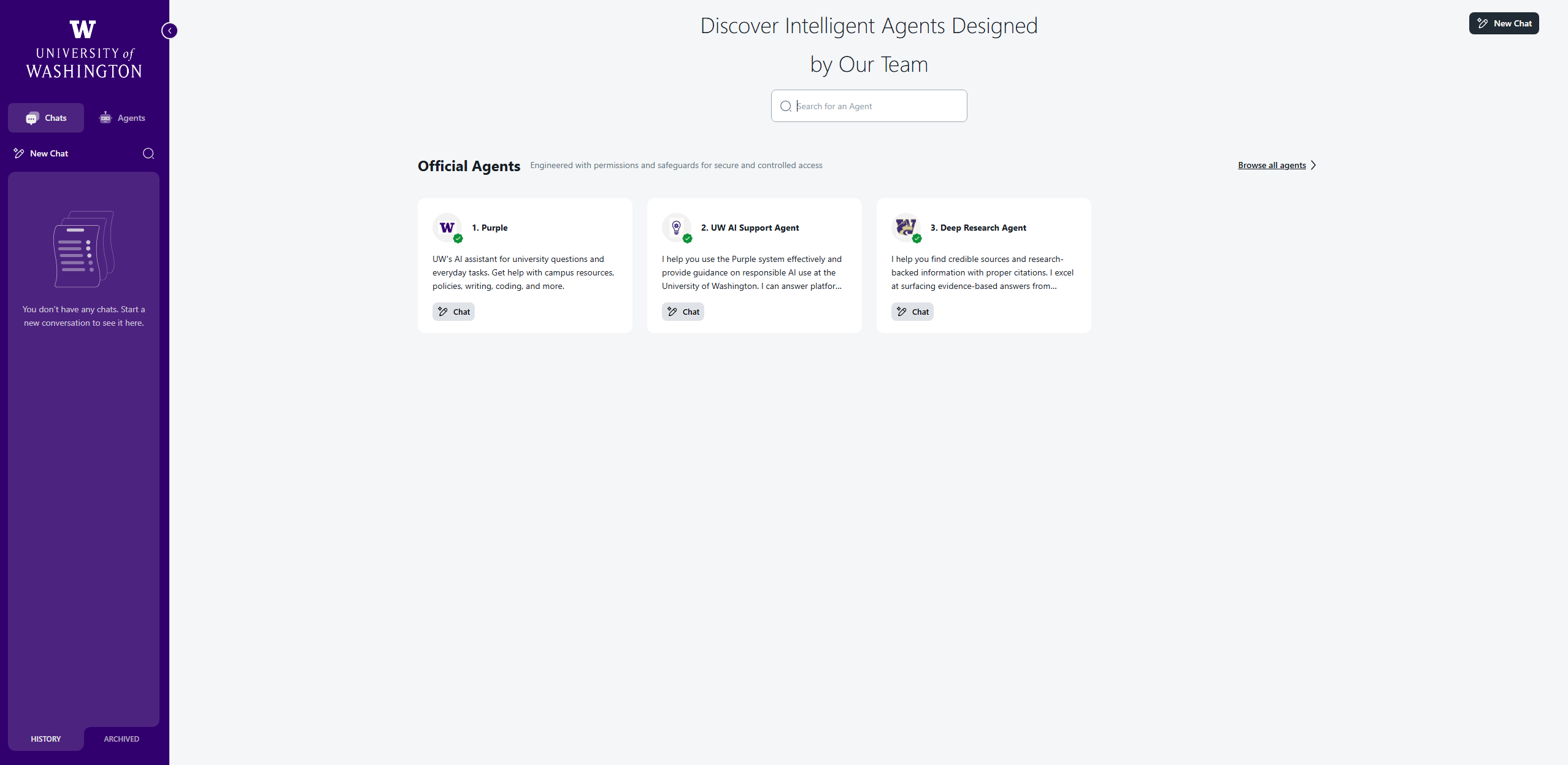
Currently, UW-IT has three official AI agents in production: Purple, UW AI Support Agent and Deep Research Agent.
Purple acts as the general-purpose assistant, helping users with writing, coding, data analysis and day-to-day academic needs. The UW AI Support Agent focuses on assisting with questions related to the platform, while the Deep Research Agent is designed for complex academic and data-driven projects.
Beyond this, the community is expanding rapidly. Integration with Canvas and a future marketplace for sharing student created agents are also on the roadmap.
“In our pilot, there were over 100 different agents built by members of the university community,” Reimer said.
This collaborative ecosystem shows how AI Purple encourages students and faculty to experiment, prototype and share their ideas, turning the platform into a living lab for innovation.
Reimer emphasized that Purple is not just a tool for using AI but a platform for building it.
“It’s a platform that allows the construction of Agentic AI applications, low-code or no-code style,” said Reimer. “You do not need to be an expert developer to build and operationalize agents, which are like mini apps built on top of the platform.”
One of the most anticipated features is Incognito Mode, which will allow users to chat privately without data being stored unless they choose to save it.
“It’s all transient and anonymous and not recorded,” Reimer said. “The other thing is we’ve made privacy commitments, and we want people to feel comfortable using it.”
Reimer added, “we have a fixed budget for three years, centrally funded by the university. We believe that we have sufficient budget to give every member of the UW community access to it, with good models.”
The initiative is being rolled out in phases and is free for all students, faculty, researchers and staff across the Seattle, Tacoma and Bothell campuses.
“Anybody with an active NetID that’s not just purely alumni will get access to it,” Reimer said.
All interested UW students and faculty are encouraged to join the AI Purple platform. Keeping in mind that this platform cannot be used by UW Medicine for now because it has not received approval from UW Medicine yet.
Students can also connect with peers, faculty and researchers through the AI Community of Practice (COP) on Microsoft Teams. With more than 1,200 members already involved, it is a great way to meet like-minded students and gain exposure to AI research happening across campus.
“We really want to try to get student awareness about the community of practice and to make them feel welcomed,” Reimer said. “There’s a lot to learn there, and a lot of good connections to make.”
As AI continues to reshape higher education and the workplace, UW’s effort to involve students directly in developing its tools stands as a model for hands-on, ethical innovation. By building together, students and UW-IT aren’t just learning about AI, they’re actively shaping its future.