Faculty fellows showcase community projects in food, schools and forests at UW Tacoma presentations
UW Tacoma’s Office of Community Partnerships hosted the 2025 Faculty Fellows in Community Engagement Public Presentations, featuring three projects focused on food production, sexual health education and riparian forest restoration.
By Syed Huzaifa Bin Afzal
UW Tacoma’s Office of Community Partnerships hosted the 2025 Faculty Fellows in Community Engagement Public Presentations on Tuesday, March 10, bringing three fellowship projects to campus for a public share-out and Q&A. The event ran 12:30–2 p.m. in JOY 207.
The presentations highlighted three projects connecting UW Tacoma faculty with local and regional partners: “From Scratch: Tasting the Tenderness in Food Production” (Yixuan Pan and Tabitha Espina, partner: Asia Pacific Cultural Center), “Including Every Body: An Educators Summit to Elevate Comprehensive Sexual Health in Public Schools” (Julia Dancis and Miranda Kucera, partner: Tacoma Public Schools) and “Restoring Riparian Forests with the Nisqually Land Trust” (EC Cline, partner: Nisqually Land Trust), according to UW Tacoma event listing.
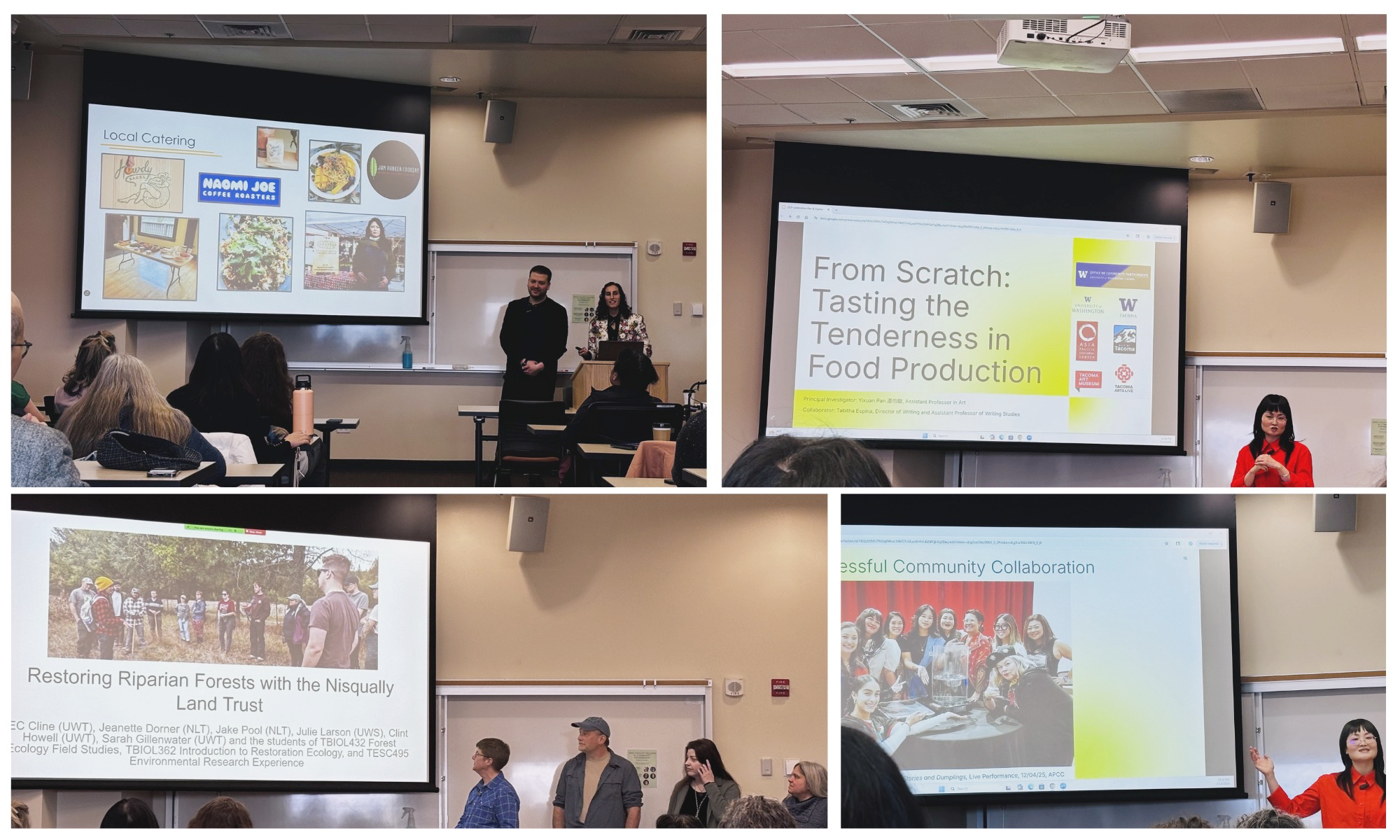
In the first presentation, Pan described a project blending performance, food-making and community storytelling to make “invisible labor” in kitchens and food systems more visible, while also connecting audiences to resources. Pan said the project was built with Asian American and Pacific Islander (AAPI) immigrant women from varied backgrounds, using live performance and community gatherings to shape the work.
Pan said the project moved from artistic practice toward concrete supports for immigrant food workers.
“We were not only provided a space to share stories and struggles, but connected our audience with concrete resources and toolkits,” Pan said in the presentation.
Pan described how attendance shaped the project’s next steps, saying the performances and panel components drew close to 400 attendees overall, and that audience feedback included interest in a future community cookbook.
The second presentation focused on a partnership with Tacoma Public Schools aimed at strengthening comprehensive, inclusive sexual health education and addressing barriers educators reported in implementation. Presenter Dancis framed the project around a simple claim: “It’s very clear that comprehensive and inclusive sexual health education benefits everybody,” while emphasizing that barriers often emerge at the implementation stage.
Dancis and collaborators described a three-day educators’ summit that brought together elementary teachers, district leadership and state-level perspectives. The project team said teacher feedback and a pilot study pointed to recurring barriers such as feeling unprepared to teach sexual health topics, uncertainty about what is allowed, and concerns about family backlash especially at the elementary level.
They also described how the summit was designed to leave practical tools behind: companion slide decks and other classroom support intended to reduce preparation burden and improve consistency across classrooms.
The third presentation, led by Cline alongside partners from the Nisqually Land Trust, focused on a practical ecological problem: tree plantings along the Nisqually River were failing at high rates and the partnership set out to test interventions to improve survival.
A Nisqually Land Trust representative described reaching out to UW Tacoma after researching faculty and identifying Cline’s work. “I went on the web and researched UW Tacoma’s list of professors and found EC’s bio and [thought] I’m going to reach out and see if they would be interested in a collaboration,” the representative said.
In the presentation, the team described sites where early plantings were experiencing close to 90–95% tree mortality and said the collaboration tested approaches such as mulching, shading, soil amendments and deep-hole planting with an auger to help seedlings access deeper moisture.
Cline also highlighted the student-learning structure behind the partnership. Cline described a “pay it forward model” where each class measures experiments planted by prior students, analyzes results and designs the next round of field projects for future classes to evaluate. Cline said the fellowship funding also supported hiring former students to help them gain experience in environmental careers.
During the Q&A, presenters returned to a common theme: partnerships take time, and the fellowship structure encouraged teams to build collaborations that can outlast a single event or quarter.
For UW Tacoma students, the Faculty Fellows presentations offered a snapshot of how community-engaged work shows in real courses, research roles and paid opportunities. Across the three projects, presenters described students participating directly whether through performance collaboration and public events, research assistance and summit planning, or field-based data collection and analysis.
Students interested in future Faculty Fellows projects can find program information through UW Tacoma Community Partnerships, which describes the Faculty Fellows in Community Engagement program as supporting collaborations between faculty and community partners and offering up to $10,000 in funding for projects tied to teaching and research according to UW Tacoma community partnership webpage.