
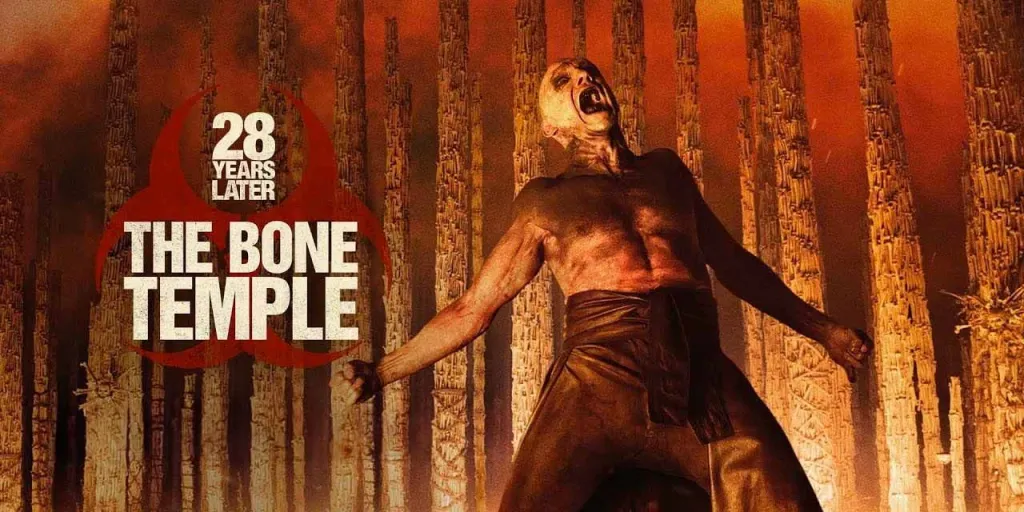
“28 Years Later: The Bone Temple” inspires hope in a world of cynicism
The new installment brings a contemplative approach to the zombie narrative.
By Ella Walken
Over two decades after its inception, the “28 Days Later” series reaches its most sensitive, cerebral point yet.
Though “The Bone Temple” may be less technically experimental than its zany predecessor “28 Years Later,” the film arguably asks more of its viewers than any prior installment in the series. The film asks us to contemplate faith and what it means to build a life worth living in a compromised world.
The film is filled with dialed-in performances which inspire contemplation. The standout performance comes from Ralph Fiennes, who is perhaps most well-known for his memorable supporting villainous performances. Films such as the Harry Potter series and most recently “The Menu” illustrate his undeniable ability to play terrifying, venomous characters. “The Bone Temple” offers a welcome departure, allowing Fiennes a blockbuster to show the full scope of his talent.
Fiennes’s Doctor Kelson is intimidating from the outside. He’s covered in iodine, residing in a field full of bone towers he built on his own. Underneath this exterior lies an intelligent and thoughtful doctor dedicated to respecting the deceased and infected above all else.
Fiennes is delicate in his portrayal, anchorColuing the viewer to what this series has always been about: the resilience of humanity. It’s hard not to become attached to Doctor Kelson as he works with Samson, an alpha zombie who he chooses to see humanity in. Every choice Fiennes makes in front of the camera lands perfectly, giving viewers a loveable, relatable character in a largely bleak cinematic universe.
This comes as a welcome contrast to Jack O’Connell’s violent cult leader Jimmy Crystal. O’Connell’s stomach-churning, campy performance is undeniably inspired by disgraced English media personality Jimmy Savile. Crystal, though not a particularly complex character, acts as a Wario to Kelson’s Mario.
Where Kelson is patient, Crystal is quick to violent anger. He leads a group of young cult members, including Erin Kellyman who gives a particularly riveting performance as a young person seeking to escape the violent world Crystal has plunged her into.
A welcome surprise to the franchise comes with the use of diegetic music in Kelson’s life. The character owns a record player and a collection of classic British records, including entries by Duran Duran and Radiohead. The most compelling needle drop of the film comes in the final act with “The Number of the Beast” by Iron Maiden.
In a world cinematic universe where characters have been stripped of their humanity, music acts as a reminder that the people on screen are just like us. They listen to Radiohead in a moment of intense focus and blast Iron Maiden to get in touch with their theatrical side.
The revelations that transpire in “The Bone Temple” leave the next film in the series with a multitude of themes, characters and plot lines to explore. The crew behind the last two films in particular have crafted this universe with such care and precision.