
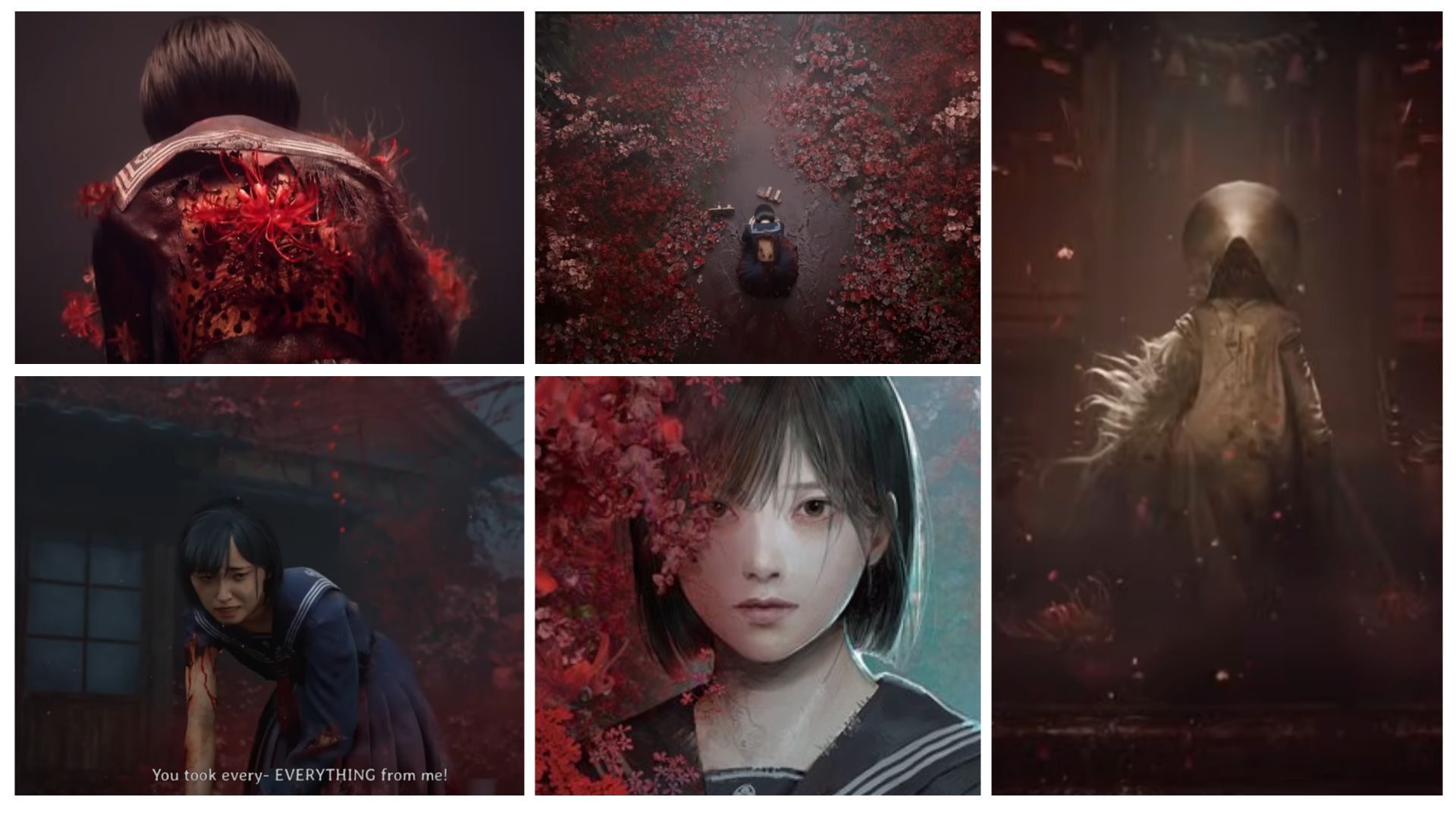
‘Silent Hill f’ delivers a disturbing story of identity and expectations.
Konami’s latest entry in the nostalgic horror series trades an American town in Maine for 1960s Japan, exploring societal expectations, identity and the loss of self in a symbolic and haunting narrative
By M.J. Cameron
Contains spoilers:
After more than a decade, Konami’s Silent Hill series returns with Silent Hill f, a psychological horror game set in 1960s Japan that confronts societal expectations of womanhood through a deeply symbolic and unsettling narrative.
The story revolves around Hinako, a teenage girl voiced in English by Suzie Yeung. Hinako doesn’t conform to the expectations of femininity. She runs track, spent time with boys during her childhood and rejected the conventional idea of what a woman should be.
Hinako’s internal conflict is shown through visits to the Dark Shrine, her Otherworld representing the pressure she faces. She encounters the Fox Man, who symbolizes Kotoyuki, the man she is arranged to marry to pay off her father’s debts.
Each visit to the Dark Shrine grows more disturbing as she makes devastating choices that symbolize the loss of her independence.
Hinako participates in three rituals, describing them as, “surrendering her body, mind and soul.”
This moment reflects her complete submission to societal roles and the erasure of her identity, where she stops being Shimizu Hinako and becomes a wife. After each sequence, the player returns to Ebisugaoka, representing Hinako being able to choose her own fate.
The cycle reflects her internal struggle between personal autonomy and the pressure to conform to societal expectations. However, the ideas remain hidden in symbolism that appears near the end of the game.
Players who don’t collect the notes, look at Hinako’s journal or explore thoroughly may struggle to understand the meaning behind her journey and what is happening.
This narrative choice can be seen as good or bad. On one hand, it aligns with the series’ tradition of complex storytelling, where critical analysis and discovery are a part of the experience. On the other hand, it risks frustrating players who expect clarity without having to explore extensively.
The delayed narrative forces players to revisit earlier moments, a choice that can frustrate those seeking a more straightforward story.
Silent Hill f offers five endings, four of which reveal Hinako’s reality: she is actually in her 20s. Everything that unfolded was a hallucination as she regressed into her teenage years to escape the responsibilities of adulthood and to seek freedom within herself.
The disappearance of her friends symbolizes their distance as they marry and move on with their lives. In all but one ending, she escapes the arranged marriage, whether through violent visions that cause Hinako to massacre her wedding guests or through a mutual decision with Kotoyuki to end the arrangement.
Fans might view the reveal as cliche, but within the context of the game it reinforces the franchise’s legacy of psychological storytelling. The revelation explains earlier events and pulls together the narrative threads.
Silent Hill f is a bold and unsettling beginning to a new era of the franchise. Like Silent Hill 3, the game explores these themes in a way that will resonate with psychological horror fans. While its storytelling can be uneven, and the themes can be hidden too deep under metaphors and symbolism, its haunting conclusion delivers a strong experience.
Players may reject or embrace its unclear and complex narrative, but the game has taken the roots of the franchise and created a Silent Hill game that marks a new modern era while remaining loyal to its legacy.