
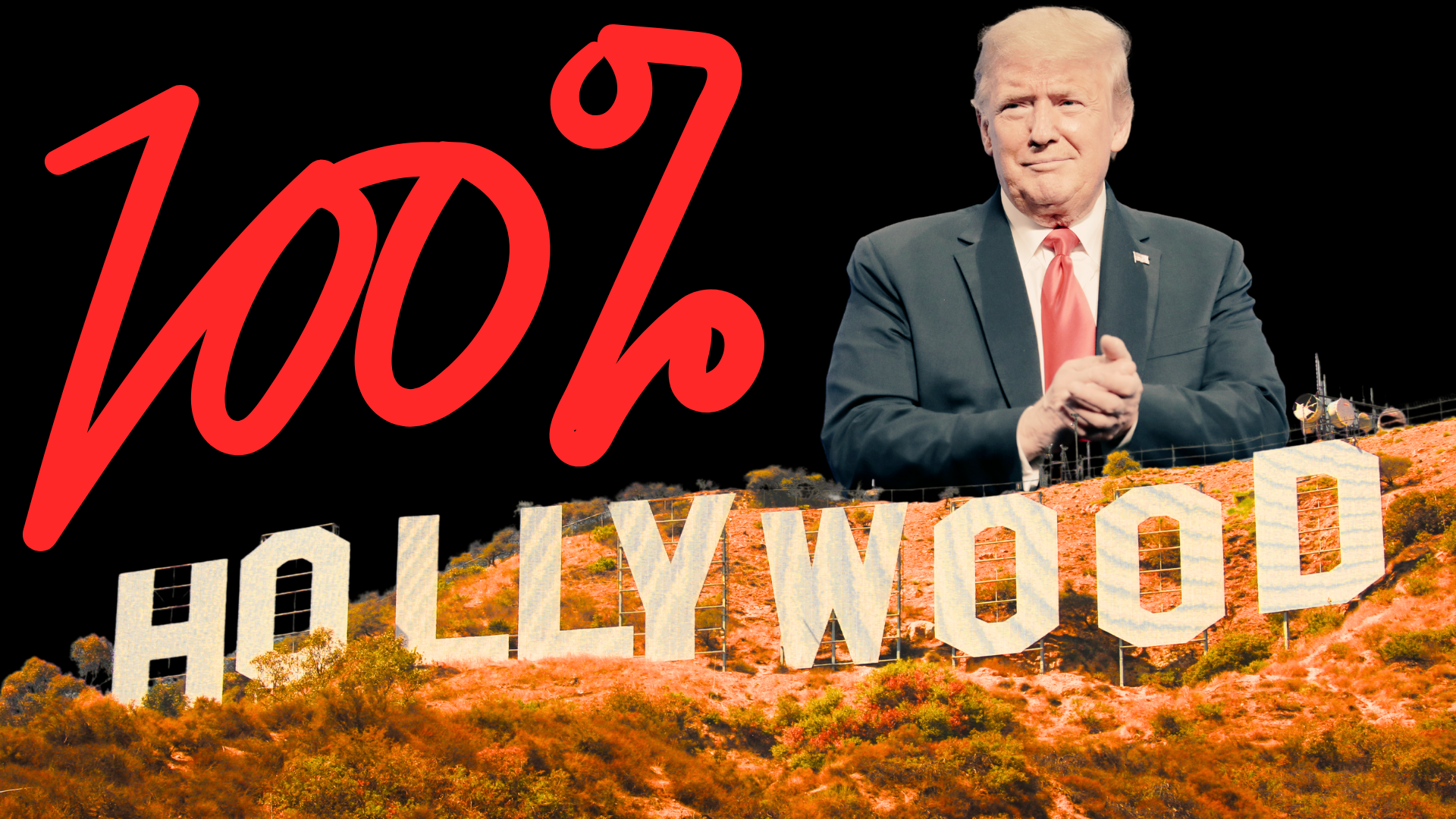
Hollywood faces uncertainty after Trump’s tariff announcement
Proposed 100% tariff leaves Hollywood uncertain amid the industry’s global production ties.
By J.A. Aleman
President Donald Trump proposed a 100% tariff on films that are produced outside of the United States on Sept. 29 through a post on Truth Social, raising questions within the entertainment industry about how such a policy would be defined or enforced.
Details of the proposal remain unclear, including whether the tariff would apply to films partially produced abroad or only to those entirely made outside the country.
Modern filmmaking often involves international collaboration, making such distinctions complex. Determining which films qualify as made outside the U.S. would require tracking where every segment of production takes place and which companies are involved.
“There is no real mechanism for determining which films contract with international teams unless a method can be developed for combing through the credits of every film,” said Associate Professor of Film & Media at UWT, Pamela Krayenbuhl.
Many large U.S. studios rely on overseas teams for post-production and visual effects work, a common practice driven by cost and access to specialized talent.
The 2023 film “Barbie” contracted visual effects companies based in the United Kingdom and Eastern Europe. The movie was also partly filmed at Warner Bros. Studios Leavesden in Watford, England, which is owned by the American studio.
It is not clear whether the tariff would apply to U.S. studios that shoot scenes abroad but maintain American ownership. Locations such as Vancouver, Canada have long been popular among U.S. productions due to cost savings and existing studio infrastructure.
The Screen Actors Guild-American Federation of Television and Radio Artists (SAG-AFTRA) said, “we will continue to advocate for policies that strengthen our competitive position, accelerate economic growth and create good middle class jobs for American workers.”
Increasing production in the United States for film and television looks to be beneficial and SAG-AFTRA also wants to keep advancing dialogue to accomplish a common goal.
SAG-AFTRA added, “we look forward to learning more about the specifics of the plan.”
Hollywood has operated as a global enterprise for decades, making it uncertain how such a measure would affect film production or distribution practices.
The global nature of filmmaking and the rise of streaming complicate any potential enforcement because digital distribution involves international licensing rather than physical importation and makes it difficult to determine how tariffs could be applied to films viewed online.
“He’s not wrong about the idea that businesses have left Los Angeles,” said Actor George Clooney when speaking to the Associated Press. “If he really wants to fix it, then we should talk about a federal incentive to keep people working. There are tons of below the line people, grips and cinematographers who are losing their jobs because work is going away to New York, Luisiana and also London.”
Serving the Second Council District of Los Angeles, Council Member Adrin Nazarian, released an official statement on Instragram.
“Loss of production to other countries is a serious cause for concern,” said Nazarian. “But cutting off the American film industry from foreign markets would also end Hollywood’s role as a magnet for talent from around the world.”
The statement also spoke of California’s Governor Gavin Newsom proposed federal tax credit of $750 billion or more for creatives to compete with other nations that give generously to their domestic film industry.
“The tariff is fascinating,” said Director Wes Anderson at the 2025 Cannes Festival. “I’ve never heard of 100% tariffs before. I’m not an expert in that area of economics, but it feels that means he’s saying he’s going to take all the money. Then what do we get?”
Since Trump’s announcement there have been no further details and at this point those in the film industry can only speculate on the possibilities or restrictions the tariffs would cause.