
UW Seattle student organization becomes campus and U-District ICE watch
UW student organization establishes an ICE watch and reporting program to counter the increasing ICE activity near UW Seattle.
By Karla Pastrana
On Jan. 17, the University of Washington’s (UW) student organization Students for Democratic Society (SDS) announced on their official Instagram their ICE reporting hotline to help protect UW Seattle’s community from the increasing ICE activity in Washington.
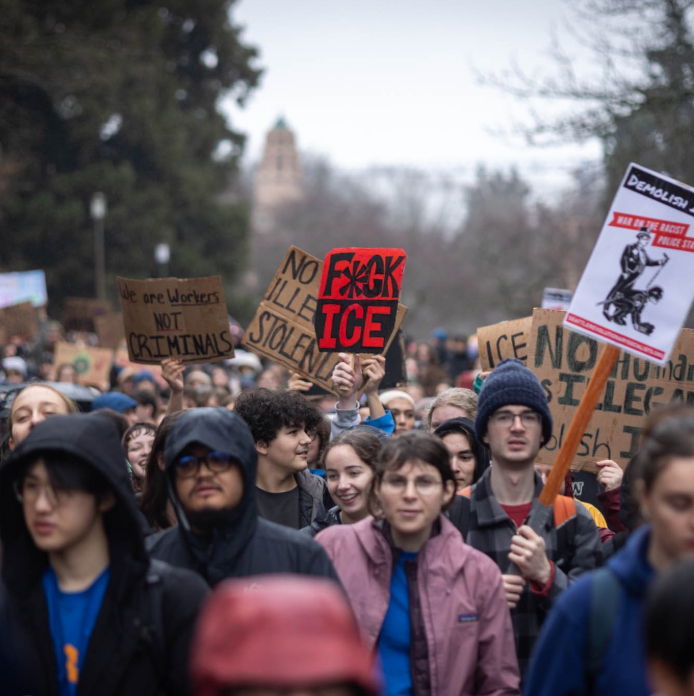
Established in 1960 to protest the Vietnam War, the SDS is a student organization that organizes, educates and empowers fellow students through nonviolent action to help bring change to their community. Some of these nonviolent actions are through campus canvassing, voter education and registration, volunteer training, political advocacy, community events and more. The SDS official page on UW’s student organization website known as The HUB states that they have solidarity with and advocate for leftist movements and policy proposals and fight for economic and racial justice in the Seattle-area and Washington State. This has led to the organization becoming the backbone of many local protests over the decades, which has led the organization to earn its hard leftist label.
Just as the SDS has stood against many issues like the Vietnam War, the SDS chose to rise to the call of action that many throughout the country have answered: protecting their immigrant neighbors from ICE. Although ICE has been highly active in other states like Minnesota, Washington state has had an increase of ICE sightings and arrests happen throughout the state, including Shoreline. These increased sightings have led many Washingtonians to voice their concerns, among them many UW students who have been asking the tri-campus administration to protect the UW community by using the UW Alert system and upholding the Keep Washington Working Act to refuse collaboration with ICE.
On Jan. 17, the SDS notified the community via Instagram that the on the evening of Jan.16 two suspected ICE agents were at U-District Grocery Store conducting a Knock and Talk interaction with the community while being dressed as civilians and bearing visible sidearms in holsters. The Knock and Talk interactions are when law enforcement approach a residences and ask to speak with the occupants, at times even ask permission to search the residence according to U.S Department of Justice. Knock and Talk interaction can happen in the absence of an arrest or search warrant due to being considered a consensual encounter between law enforcement and civilians if permission is granted to law enforcement.
The two men asked to enter U-District Grocery Store but were turned away by witnesses when they told them the store was closed. The men left the establishment and didn’t arrest anyone nor showed any aggression, but the interaction left witnesses shaken due to how suspicious the men acted and has led to the already high concerns about safety to increase within the UW Seattle community.
Eventually, through a classified credible source and investigation, the SDS found out that two suspected men were actual ICE agents.
The day before the ICE sighting on Jan 16, many within the UW community received notices via Reddit, Instagram or other forms of unofficial campus communications that there was a possibility that ICE would be in the U-District in plainclothes throughout the weekend. These messages were sent on the evening of Jan. 15 and into the following morning.
The UW’s spokesperson Victor Balta told The Daily that the administration does not have verified information about ICE on or near campus. Likewise, U.S. Customs and Border Protection spokesperson told The Daily via email that they don’t confirm or provide advance notice about where their agents will be therefore having no contact with the university.
“[After the ICE sighting] it was a very tense and stressful period, especially the first two weeks. People were scared but people knew they weren’t alone,” says UW SDS’ Outreach Chair Natalie LaFlamme. LaFlamme was one of the many SDS members who responded to the U-District sighting. Like many SDS members, LaFlamme was an activist long before joining SDS and is a member of the Community Patrol.
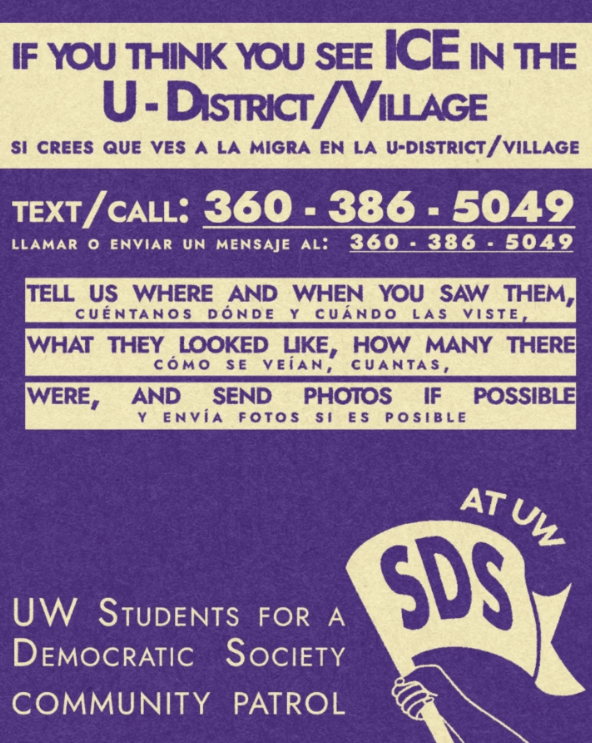
As a response to the increasing community concerns and ICE activity near UW, the SDS held an emergency meeting on Jan. 17 to form and announce their ICE watch and reporting system- UW Students for a Democratic Society Community Patrol (Community Patrol). A system that protects the campus, U-District, and U-Village altering the community of ICE presences.
The Community Patrol network is a hotline where community members can call or text to report ICE or suspicions of ICE activities within the UW community. The hotline asks people to use the SALUTE protocol which is a detailed and quick observation report that the military and law enforcement use. The Community Patrol also encourages people to send visuals like photos of what they see if it is possible to help them notify members and alert the community of the sighting through their Instagram Story.
Once a report is sent to the Community Patrol, members will be sent to the scene to investigate and confirm the sighting. If the sighting is confirmed and agents are conducting arrests, Community Patrol members will ask agents for identification, warrants and reason behind the arrests while also obtaining information of the detainee, like their name and a family member’s phone number to notify them of their arrest. At the same time, the Community Patrol will be documenting the encounter. Community Patrol members that are sent to the scene and out in patrol are members that have been trained in rapid response, a training all members must do before they enter the patrols in order for them to know how to interact with ICE and obtain documentation and information correctly.
Yet, no matter what ICE is doing within the Community Patrol’s zones, the Community Patrol will alert the UW community of their presence through the SDS’ Instagram Story with information on where they were spotted and identification information.
According to the SDS, the Community Patrol was established to create more sustainable patrols and rapid response to help their members and community partners defend the community because prior to the system their members and allies were patrolling without a network to rely on. Prior to its creation, the SDS was doing small patrols and investigating ICE rumors since early January due to the lack of action from the tri-campus administration.
“The only reason we have put [the patrols] in place is because of admins refusal to do even the bare minimum to protect their staff, students and workers without tremendous outside pressure. This is something UW could do for its community, and the fact that it hasn’t is speaking volumes,” says LaFlamme.
LaFlamme tells The Ledger that since the announcement of the Community Patrol, the SDS has received a large wave of community support from the UW community. Bars and restaurants surrounding UW Seattle have printed hundreds of posters to hand out or simply post them up within their establishments for the community to be aware of the hotline. At the same time, many have been contacting the Community Patrol about suspicious activities they see around the area. Many of the reports were false alarms but to LaFlamme it is a testament to showing how the UW community cares about their neighbors by staying vigilant.
However, there have been two cases where the reports were confirmed to be true, one that happened Jan. 26 and the second occurring Jan. 30.
The first confirmed sighting to the Community Patrol involved a vehicle labeled “Immigration and Customs Enforcement” at a gas station in Capital Hill. A community member reached out to the Community Patrol Hotline which led to the SDS to alert community members of the sighting.
The Jan. 30 sighting involved the same undercover agents from Jan 16. They were spotted once again near the U-District Grocery Store at the same time they were there Jan. 16. The SDS notified the community that they had increased patrols around the U-District that night to keep an eye out for them. There were no arrest nor interactions reported between community members or Community Patrol with the men.
SDS has shown no signs of backing or slowing down their Community Patrol program. The SDS invites the community to join them in their patrols, from individuals to organizations. They also encourage the community to save the Washington Immigrant Solidarity Network Hotline (WISNH) to their phones to help report ICE activity throughout the state. The WISNH also serves as a hotline that provides verification of ICE activity, referrals for immigrants and provide callers with information on their rights. LaFlamme also adds and encourages people to attend any local rapid response training hosted by WISNH. These training sessions happen once a month.