
UW drafts 2026–30 strategic plan: Tacoma leaders encourage student feedback
UW’s draft for the 2026–30 strategic plan is open for feedback through April 17, with priorities meant to guide all three campuses.
By Syed Huzaifa Bin Afzal
The University of Washington has released a draft of its 2026–30 strategic plan and is asking students, faculty and staff across its three campuses to submit feedback by April 17, according to the UW Strategic Planning website. The draft plan, titled “Built for the Moment – Advancing the Future,” is available online along with a feedback form and downloadable document, including a PDF version of the draft.
The release represents a major milestone in UW’s strategic planning process. In a short video announcing the draft, UW President Robert J. Jones and Provost Tricia Serio said the plan is intended to provide “a shared framework for guiding priorities” and aligning work across UW’s three campuses and UW Medicine, according to the university’s video message. Serio said it would be UW’s first comprehensive, university-wide strategic plan in about 15 years.
UW leaders emphasized that the plan is still a draft. Jones and Serio wrote that the current phase is designed to gather ideas from faculty, staff, students, alumni and partners before the plan is finalized later this spring, according to a message from the Office of the President.
The plan has also drawn attention in student media. The Daily, UW Seattle’s student publication reported the university released the draft and opened a campuswide feedback period, summarizing key priorities and highlighting the effort to collect comments before the plan moves to approval stages.
UW’s draft-plan page directs community members to review the document and submit feedback through an online form. The draft-plan page encourages unit-level discussions and collective feedback, while also allowing individuals to submit comments directly through the linked survey. A strategic planning timeline posted by the university shows the draft review period in March and April, with a goal of finalizing the plan in spring 2026.
The draft was developed by a 62-member strategic planning committee made up of faculty, staff and students, according to the committee roster and overview. Based on the public roster, the committee appears to be primarily Seattle-based, with seven members explicitly listed as UW Tacoma and six listed as UW Bothell, while the remaining members are affiliated with UW Seattle schools, central administration or UW Medicine. The committee’s listed work includes a tri-campus survey, listening sessions and targeted engagement intended to inform the draft before public release.
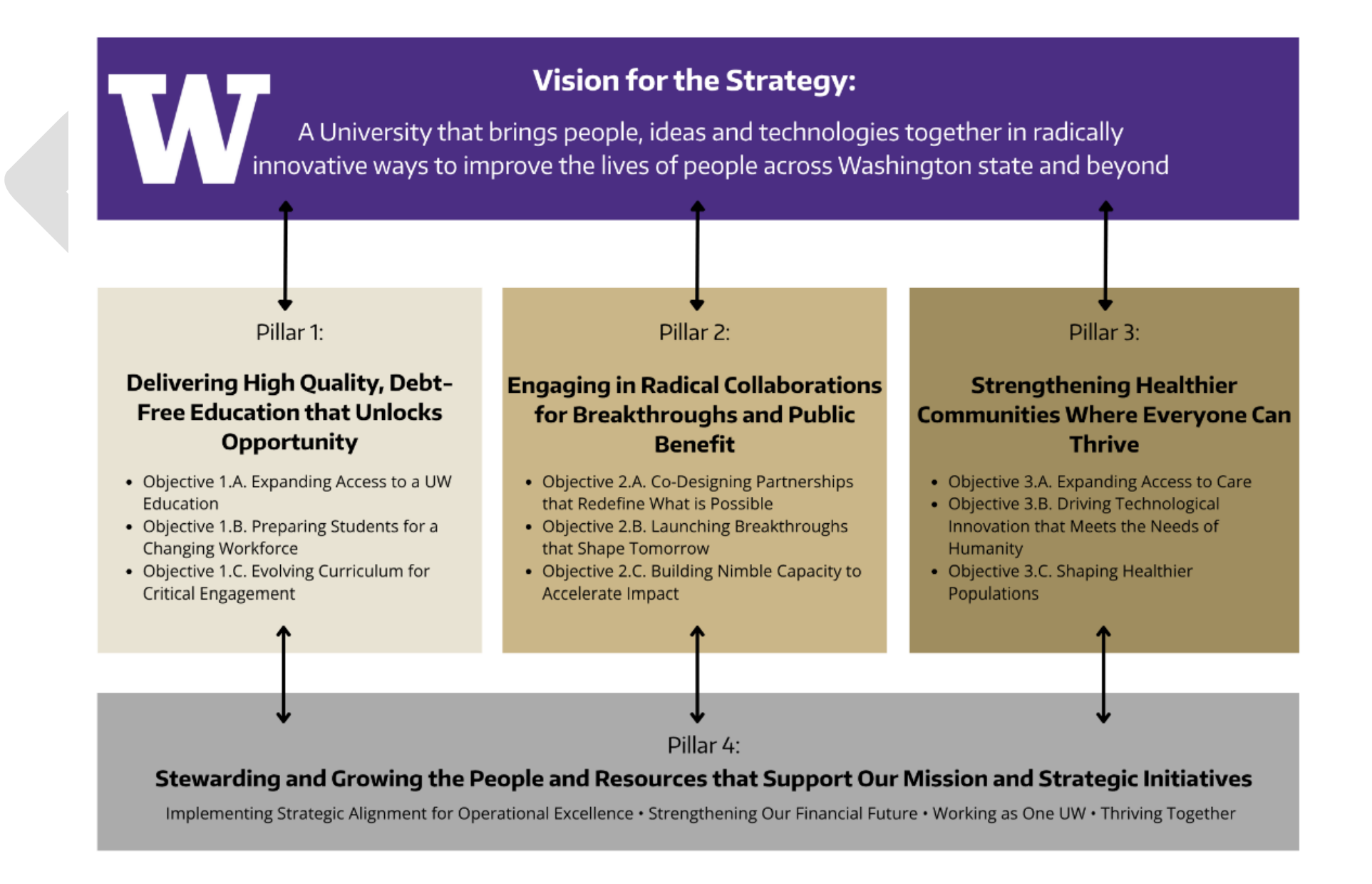
The draft plan is organized around four pillars. The first pillar centers on delivering high-quality, debt-free education that “unlocks opportunity,” including an aspirational goal that Washington undergraduate students could earn a UW degree without taking on debt, as described in the draft plan. The draft also points to career readiness and preparation for a changing economy, including emphasis on skills such as artificial intelligence literacy and digital fluency.
A second pillar focuses on “radical collaborations” for research breakthroughs and public benefit, highlighting partnerships and investments in research infrastructure. A third pillar focuses on healthier communities, including UW Medicine’s role and expanding access to care. The fourth pillar emphasizes stewarding people and resources and includes a tri-campus “Working as One UW” objective that discusses shared courses, reducing barriers between campuses and simplifying policies such as intercampus credit transfer, according to the draft plan text.
From a UW Tacoma perspective, Amanda Figueroa, associate vice chancellor for social mobility in the Division of Student Affairs, said Tacoma students are likely to feel Pillar 1 most directly because it emphasizes affordability and frames financial background as a barrier the university aims to reduce.
“Given UW Tacoma’s student demographics, that framing matters,” Figueroa wrote in an email. She also pointed to career readiness language as an area students may focus on in a “challenging and changing labor market.”
Figueroa said students should also read the “Working as One UW” language carefully, since it could raise questions about access to services and resources across campuses. She wrote that those questions are “exactly the kinds of issues students should name during the feedback period,” noting that detailed implementation steps have not yet been developed.
Figueroa said strategic plans set big-picture priorities rather than spell out immediate operational changes. “They answer the ‘what’ and the ‘why,’” she wrote. “They do not yet spell out the detailed ‘how.’” She said the next phase how priorities translate into actions would follow after the final plan is approved by the Board of Regents.
On cross-campus course access, Figueroa said the draft signals interest in reducing barriers between campuses, but there is not yet an implementation plan that details specific changes or timelines for shared courses or credit transfer. She encouraged Tacoma students to use the feedback window to identify whether cross-campus access is a priority and to raise concerns about how it should work in practice.
Figueroa said the draft’s “debt-free education” language should be understood as an aspirational direction rather than a finalized funding model or guarantee. She wrote that the draft does not yet outline specific strategies for achieving the goal and said later phases would likely involve multiple approaches such as fundraising, cost control and resource allocation.
For Tacoma students who want to participate, Figueroa emphasized that the most direct avenue is the university-wide survey linked from the draft-plan page. She encouraged students to submit feedback and to share the survey with classmates so Tacoma perspectives are documented during the review period.
Figueroa also noted that UW Tacoma’s current campus strategic plan runs through the 2026–27 academic year and that future campus-level planning will likely align with the new university-wide plan. She pointed students to UW Tacoma’s strategic plan metrics page as an example of how progress is typically shared publicly, and said students interested in campus-specific next steps could also seek details through Tacoma leadership channels.
In her message, Figueroa encouraged students to read the draft and ask whether their experiences and communities are reflected. “Students on our campus bring perspectives shaped by the South Sound, by work and family commitments, and by pathways that come together to create the unique Tacoma experience,” she wrote. “Naming what feels absent or underdeveloped is one of the most powerful forms of feedback available right now.”
With the draft plan now open for comment, UW leaders are asking students, staff and faculty across Seattle, Tacoma and Bothell to weigh in before the April 17 deadline. For UW Tacoma students, the feedback period is a chance to respond to priorities that directly touch affordability, career preparation and how “One UW” might work in practice, before the university moves from broad goals to specific implementation after Board of Regents review.