
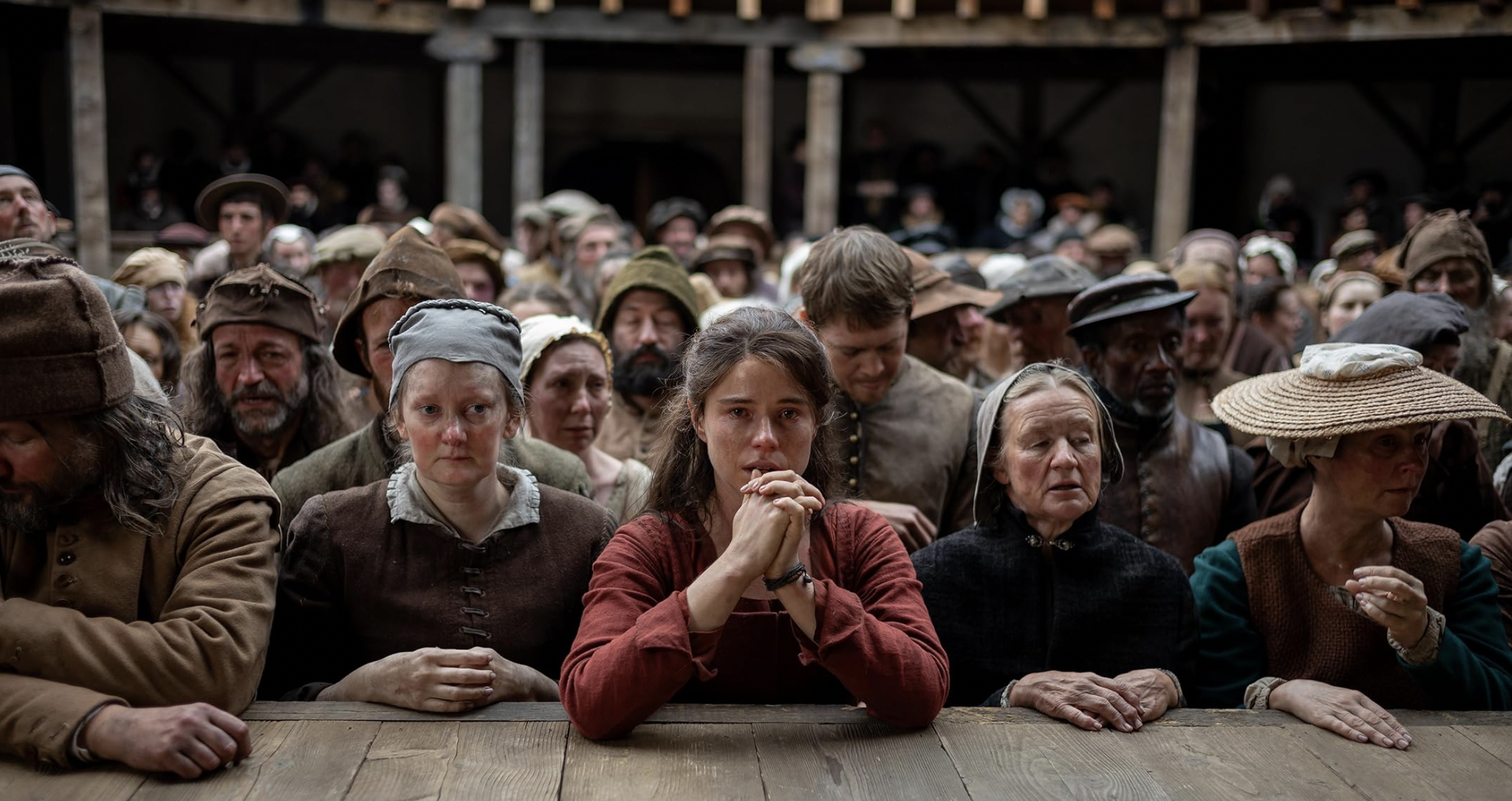
“Hamnet” aims for tragedy but settles for emotional overkill
The Oscar frontrunning film forgoes a complex portrayal of grief for emotional manipulation.
By Ella Walken
As the 2025-2026 awards season ramps up, the frontrunners for the Academy Awards, BAFTA, and Critics Choice Awards are coming into focus. One of these films under significant spotlight is Oscar winning director Chloé Zhao’s “Hamnet”, a slice of life film about William Shakespeare and the events that inspired his masterpiece tragedy “Hamlet.”
The film, an adaptation of the Maggie O’Farrell novel of the same name, stars Paul Mescal as a young Shakespeare and Jessie Buckley as wife Agnes as they fall in love and soon become parents. Their children soon fall ill, which eventually results in great tragedy.
While often technically impressive, “Hamnet” portrays grief with the subtlety of a brick to the head. One could argue that any piece of art is inherently emotionally manipulative, but Zhao seems to be pushing all faders to the maximum.
Despite a clunky script, the film does present two fantastic performances. The most striking performance in the film comes from 12-year-old Jacobi Jupe. Prior to playing the titular Hamnet, Jupe had only starred in two screen projects, which makes his heartwrenching turn all the more impressive.
Jupe is the beating heart at the center of “HAMNET.” The young actor exceeds both in scenes which require him to be a quiet support as well as moments that rest entirely on his shoulders.
Buckley leaves it all on the court, which makes critiquing a performance so raw feel borderline cruel, but it would be disingenuous to ignore the shortcomings of how her character is situated within the remainder of the piece. The screenplay, written by Zhao and O’Farrell, allows Buckley to display her capacity for a fully embodied performance. We see the manifestations of Agnes’s pain, both the physical and mental.
Though the role is demanding, Agnes as a character is kept relatively surface level. We learn a bit about her family history, but any exploration about her motivations beyond protecting her children is ignored.
Paul Mescal’s William Shakespeare receives a similar treatment. We are given a bit more information about his history than Agnes, but it’s still sparing. The audience never really learns anything about Shakespeare as a human being. We know that William and Agnes love each other, but we never really learn why.
Often, love is something that is beyond an eloquent explanation. The audience doesn’t need either character to speak directly into the camera in order to understand what exactly compels them to each other or keeps the love alive, but little context or development is offered. Buckley and Mescal, while both incredibly talented actors doing their best with what they are given, lack tangible chemistry.
Narratively speaking, the children seem to only exist to be born and die. The viewers never really find out who they are or how their parents feel about them beyond love.
The lack of specificity permeates the entire film and leaves such a tender subject matter feeling overwrought and misguided in its lack of depth. “Hamnet” isn’t really about anything. If it isn’t about Agnes, or William, or their relationship, or their children, who or what is this film about? It is very obviously about parental grief, but it fails to really explore the longlasting aftershocks of such a tragedy.
The most frustrating moment of the entire film also comes at its most triumphant scene: the ending. As the film comes to a conclusion that is so emotionally fragile and layered, Max Richter’s piece “On the Nature of Daylight” is played over the scene. This song has been utilized in over 20 films and television shows to date. Some of the most notable entries include “Shutter Island,” “Arrival,” and an episode of “The Last of Us.”
The problem isn’t the song itself. There is a reason this piece has been used many times. “On The Nature of Daylight” is haunting and pulls the listener through audio landscapes that draw up feelings of longing and regret. The problem is the disregard for creating something new. In its most crucial moment, “Hamnet” pulls out a cliche crutch instead of taking the risk of utilizing an original piece of music. It is a needle drop that almost begs the audience member to cry.
Do Zhao and Max Richter not think their audience is capable of experiencing the sorrow portrayed onscreen without the reminder of every other tragedy this song has underscored? Why didn’t Richter write a new piece to allow the viewer a fresh reflection on grief and acceptance?
“Hamnet” seems to be, almost top to bottom, a film which is selling itself short. For a film so emotionally raw, the execution of these themes shies away from nuance or complex portrayals of grief. “Hamnet” offers an important reminder: a film forcing its audience to tears doesn’t make it good.